Karla Plevová Group
Genomics of Immune Cells
The team builds on its recent experience and work on projects focused on understanding the impact of inherited and acquired genomic variants primarily in cancer cells. Such studies are complemented with the assessment of gene expression, epigenetic modification and chromatin accessibility. Some genomic variants are very complex, even spreading over several chromosomes; thus, it is necessary to employ a multi-faceted analysis including several genomic, cytogenomic and computational methods to reveal their native structure and consequences on genome expression. Furthermore, genome reorganization due to chromosomal defects radically changes interactions of genomic regions which can trigger aberrant expression. Hence, a part of the research is devoted to analyzing chromatin interactions and interacting domains, such as topologically associated domains (TADs). Finally, tumor progression is typically associated with intra-tumoral heterogeneity, which is studied using technologies with single-cell resolution and mathematical models.
The experiments above generate a considerable amount of data, for which the team implements appropriate and advanced analytical procedures. If any of the results have the potential utility in clinical practice, the team develops user-friendly tools for their evaluation. Similar approaches are used for sharing the most interesting findings with the scientific community via interactive websites.


Research Group Objectives
- Study genomic defects, including gene mutations and chromosomal abnormalities of various extent, contributing to disease onset, progression and resistance.
- Explore the impact of genome structure and interaction perturbations on pathological conditions.
- Evaluate expression and epigenetic changes altering cell features and fate.
- Introduce advanced genomic methods (e.g., third-generation sequencing, single-cell technologies, computational approaches) to explore the human genome in the research context but also diagnosis.
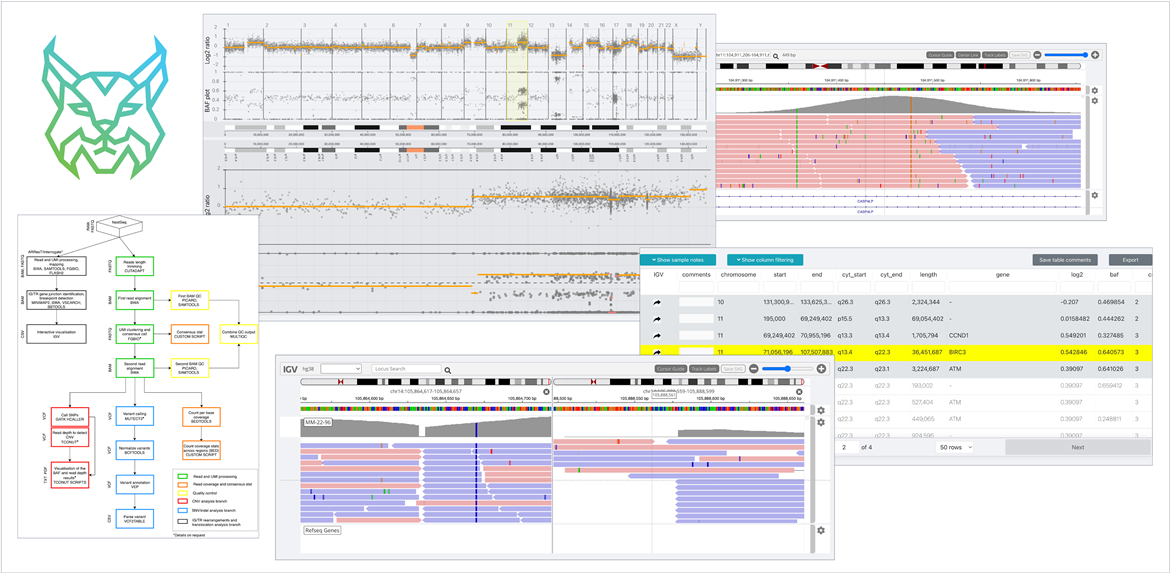
- Develop computational tools for the analyses and visualization of genomic data aiding their straightforward interpretation.
Specific Research Topics
- Deciphering complex structural variants in the cancer genome using advanced sequencing methods.
- Exploring abnormal chromatin interactions arising from genomic rearrangements in cancer cells.
- Analysis of chronic lymphocytic leukemia cases with multiclonal cellular origin.